Citizen-X
A politically neutral decision-mapping system built during the Tamil Nadu election cycle, where policy data was incomplete, timelines shifted, and interpretation quality determined trust.
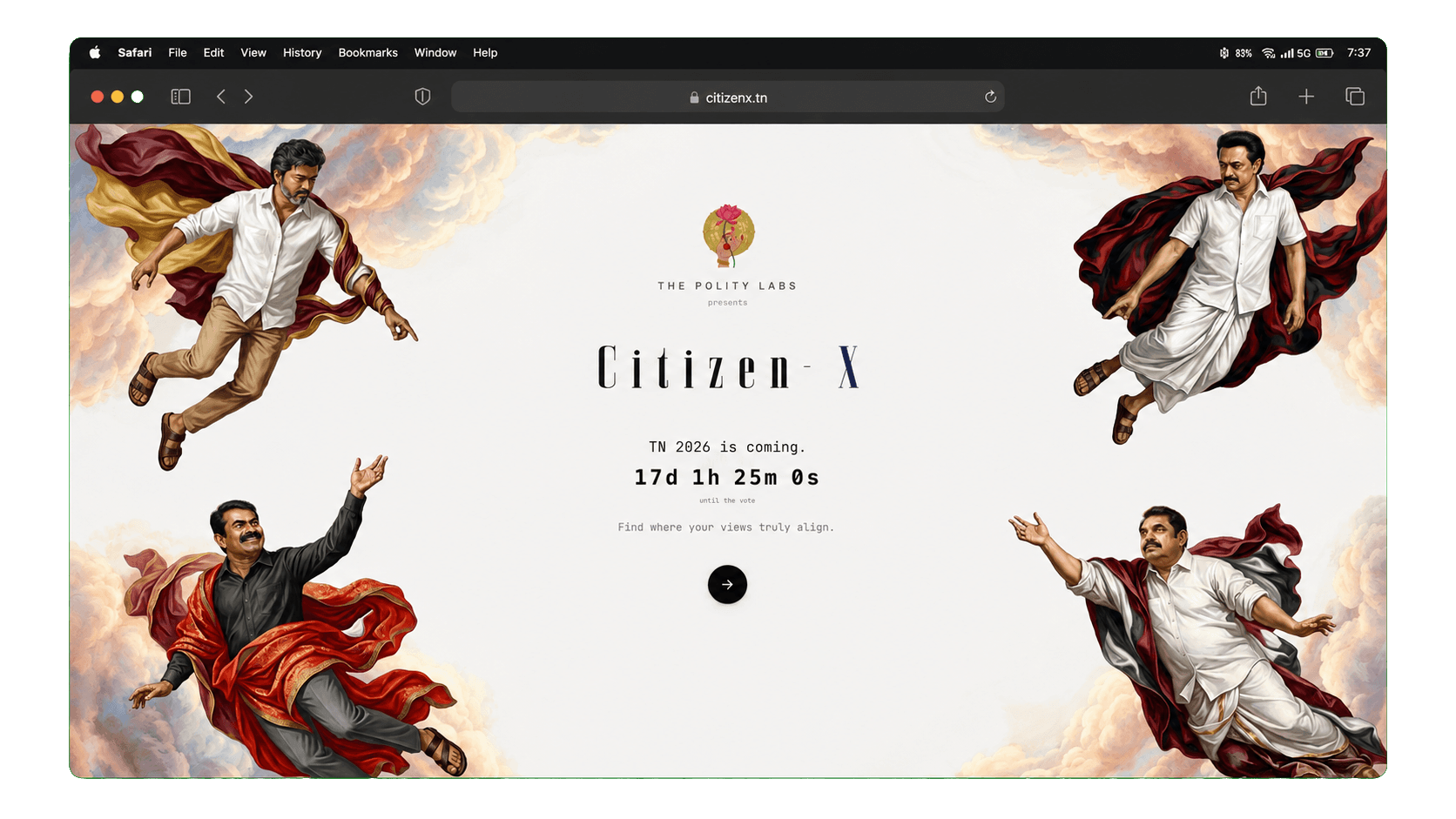
Why this matters
During the Tamil Nadu election cycle, voter decisions were often shaped by headlines, identity, and fragmented information rather than direct policy comparison. Citizen-X explored whether manifesto positions could be translated into a structured decision system that remained understandable, transparent, and politically neutral under real election timelines.
The Problem
The design problem was operational, not cosmetic: build a system that could sustain political neutrality while policy sources changed in real time and some parties withheld or delayed official manifesto detail until late in the election cycle.
- Manifesto completeness varied sharply across parties, creating uneven evidence quality for policy mapping.
- The questionnaire needed to represent ambiguity instead of forcing false certainty into binary matches.
- Weighting choices required multi-perspective review to reduce interpretation drift and partisan framing risk.
Core Insight
Political alignment is not a binary preference problem - it is an interpretation problem. Most civic tools compress nuance into oversimplified scores. Citizen-X focused on exposing reasoning, weighting tradeoffs, and handling uncertainty instead of pretending certainty.
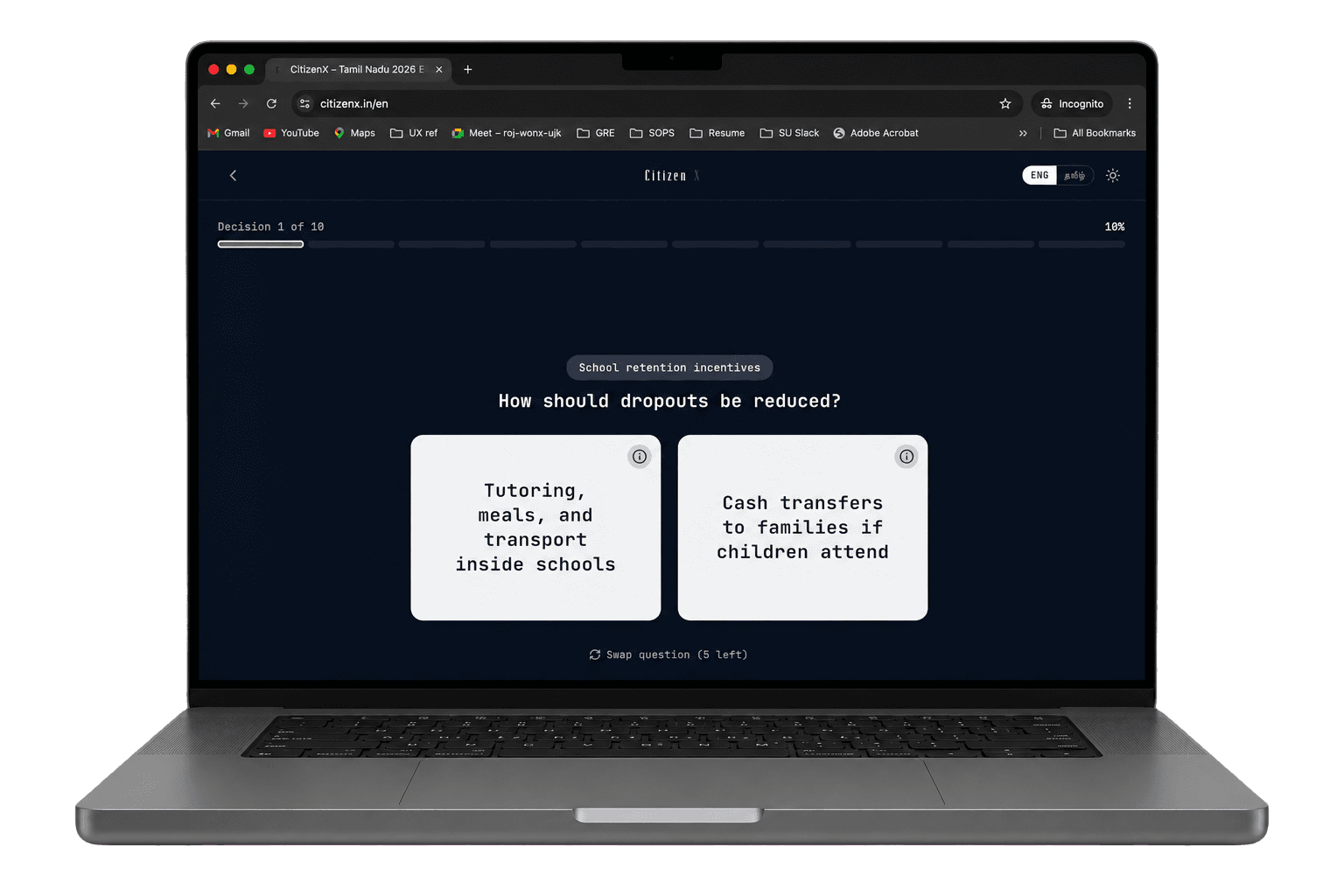
Issue-by-issue tradeoff flow used during live cycle testing
Early Signals
Citizen-X reached roughly 2,000-3,000 users organically during the Tamil Nadu state election cycle through short-form social distribution without paid marketing.
- Users engaged more with issue-by-issue tradeoff comparison than final ranking outputs.
- Users spent more time revisiting issue tradeoffs before checking final alignment outputs.
A consistent pattern emerged:
The strongest pull was not finding a single best match - it was understanding why positions diverged across issues under real uncertainty.
Bias Reduction
The project intentionally included collaborators with different policy perspectives to challenge interpretation consistency and reduce unilateral weighting bias.
Where ambiguity existed, manifesto excerpts and public statements were cross-reviewed and compared before weights were finalized.
Operational Constraints
- Manifestos were released at different times across parties
- Some policy positions required inferred mapping before official publication
- Policy stances evolved during the active campaign period
- Weight recalibration occurred after manifesto releases
Design Approach
- 1.
Mapped pre-manifesto positions from speeches, interviews, campaign statements, and public appearances so users could compare before decision urgency peaked.
Why it mattered: Live election timing pressure meant waiting for complete manifestos would delay usefulness until after peak decision moments.
- 2.
Recalibrated policy mappings and weights as official manifestos were released, replacing inferred positions with verified manifesto evidence.
Why it mattered: Dynamic recalculation preserved momentum early while improving recommendation fidelity as source quality improved.
- 3.
Designed outputs around rationale and tradeoff visibility rather than a single winner score.
Why it mattered: When policy language is ambiguous, transparent reasoning is more trustworthy than high-confidence ranking theater.
Decision Mapping System

Impact
- Validated that political neutrality depends on repeatable interpretation workflows, not interface tone alone.
- Demonstrated that ambiguity handling can increase trust when confidence and sourcing are explicit.
- Established a maintainable recalibration path for shifting manifesto releases during active campaign timelines.
- While initially tested during the Tamil Nadu state election cycle, the underlying comparison model was intentionally structured to adapt across different electoral systems and policy environments.
Reflection
Current limitation:
The hardest problem was not interface clarity - it was maintaining interpretive consistency under incomplete and evolving political information. Small wording changes could significantly alter perceived alignment outcomes.
Next iteration focus:
Reduce ambiguity in policy mapping, expose confidence levels more explicitly, and separate verified manifesto positions from inferred campaign statements within the recommendation flow.